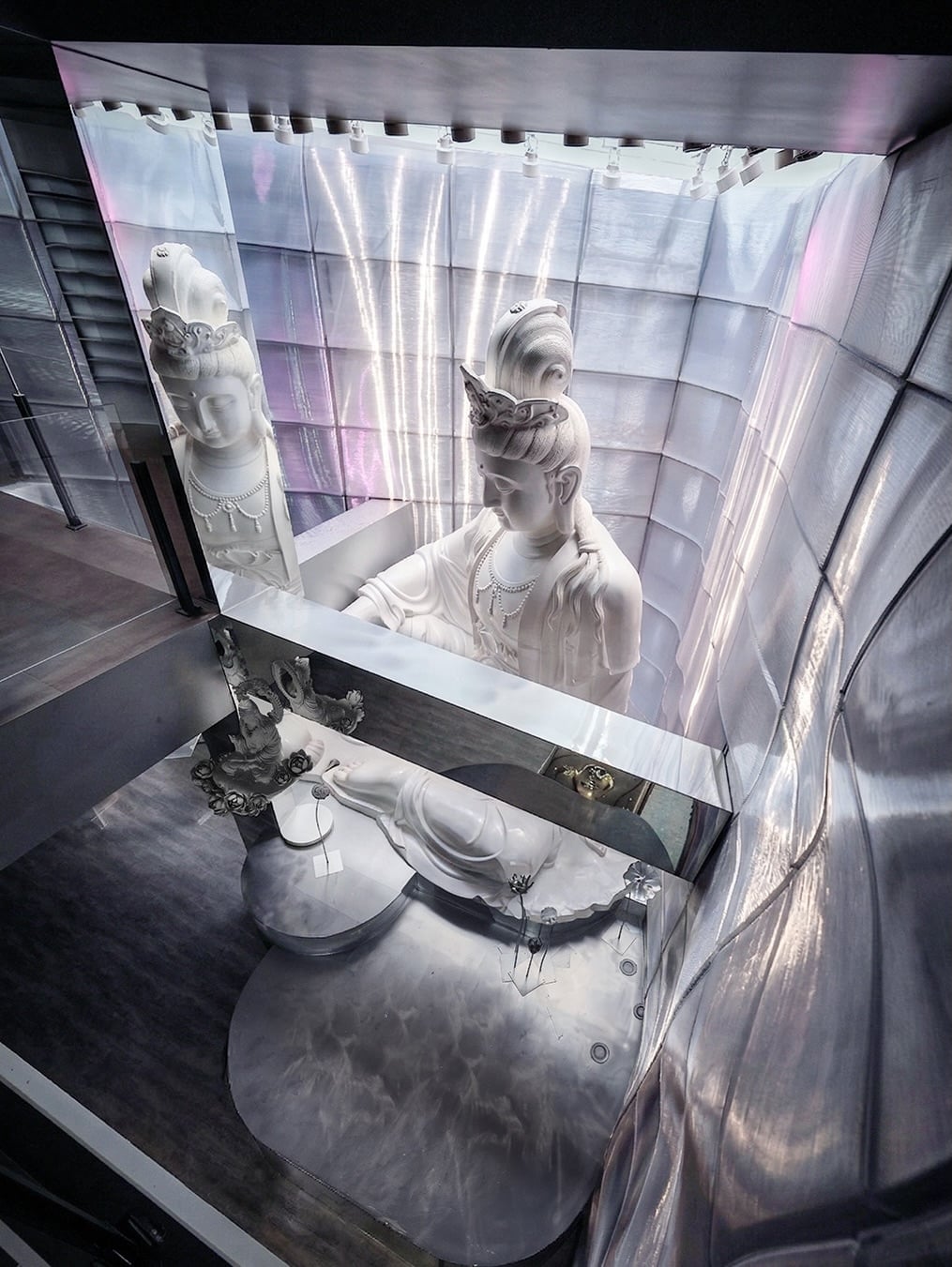
Sky Religion (天光願) occupies a narrow building inside Linjiang Street Night Market, commonly known as Tonghua Night Market, in Taipei’s Da’an District. The site had previously been a steakhouse and remained closed for more than a decade. Rather than imitate a freestanding traditional temple, Daniel Hu Interior (覺知造所) adapted the existing building and placed a Buddhist space directly into the commercial life of the night market.

The route begins by sending visitors down to a basement worship hall. From there, a spiral staircase rises toward a four-meter Guanyin statue, bringing visitors close to the figure at eye level before leading them out through a rear exit. The progression moves from a dark lower level toward a brighter upper space, turning the building’s limited height and divided floors into part of the ritual.

Inside, layered dark ceiling elements and narrow linear lights reinterpret the visual rhythm of traditional temple brackets. Mirrors and reflective wall panels carry light into the lower level while multiplying the statue and dissolving some of the room’s boundaries. The temple also enshrines Aizen Myoo and Benzaiten alongside Guanyin, and offers fortune slips associated with Tokyo’s Senso-ji. It stays open until 11 p.m., allowing people to enter after work or while visiting the night market.
Responses beneath the Instagram post were divided. Several commenters praised the mirrored surfaces and visual drama. One visitor said the space was attractive as a design project but did not produce the calm they expected from worship, describing the large statue and surrounding beams as oppressive. Another said the interior worked better as a store design. The comments reveal the project’s central tension: its striking architectural image does not create the same religious experience for everyone who enters.