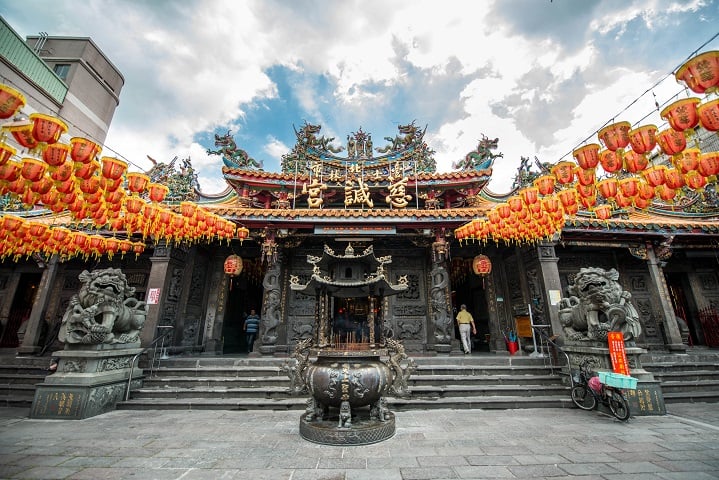
Cixian Temple (士林慈諴宮) sits inside Shilin Night Market in northern Taipei. The market now surrounds the temple, but the temple and its forecourt came first.
The temple’s official history traces its founding to 1796 in the old Zhilan commercial district, where goods moved by water and merchants prayed to Mazu for safe transport. After the temple and its surrounding settlement were burned during fighting in 1859, local leaders rebuilt it at its current site in 1864 as the center of a planned new street.

VERSE reports that trading was concentrated in the square before the temple by 1909. Construction of a public market across from the temple began in 1913, and the market opened in 1915. The project was part of a wider colonial policy that moved itinerant vendors into public markets in the name of sanitation and disease control. Its two long brick buildings used timber roof frames, raised vents, and large arched windows for light and airflow. Taipei designated the surviving buildings as a historic site in 1998.

The district changed again as nearby colleges brought large student audiences to Shilin. By the 1960s, the area had five movie theaters. VERSE dates the recognizable Shilin Night Market to 1959, when it occupied a smaller stretch from Anping Street beside Yangming Cinema to the temple forecourt. After covered canals became new roads in the 1970s, more vendors arrived and the night market spread farther through the neighborhood.

Fire-safety and sanitation concerns eventually led Taipei to rebuild Shilin Market. Vendors began moving to a temporary market in 1998, postwar additions were demolished in 2002, and work on the replacement was repeatedly delayed by planning changes, restoration of the historic buildings, and revisions to public facilities. The rebuilt market was completed in 2011 after 12 years. Food stalls were placed on the first basement level partly because planners limited the building’s height in deference to the historic temple across the street. The market’s form kept changing, but commerce continued to organize itself around the same temple and street network.
