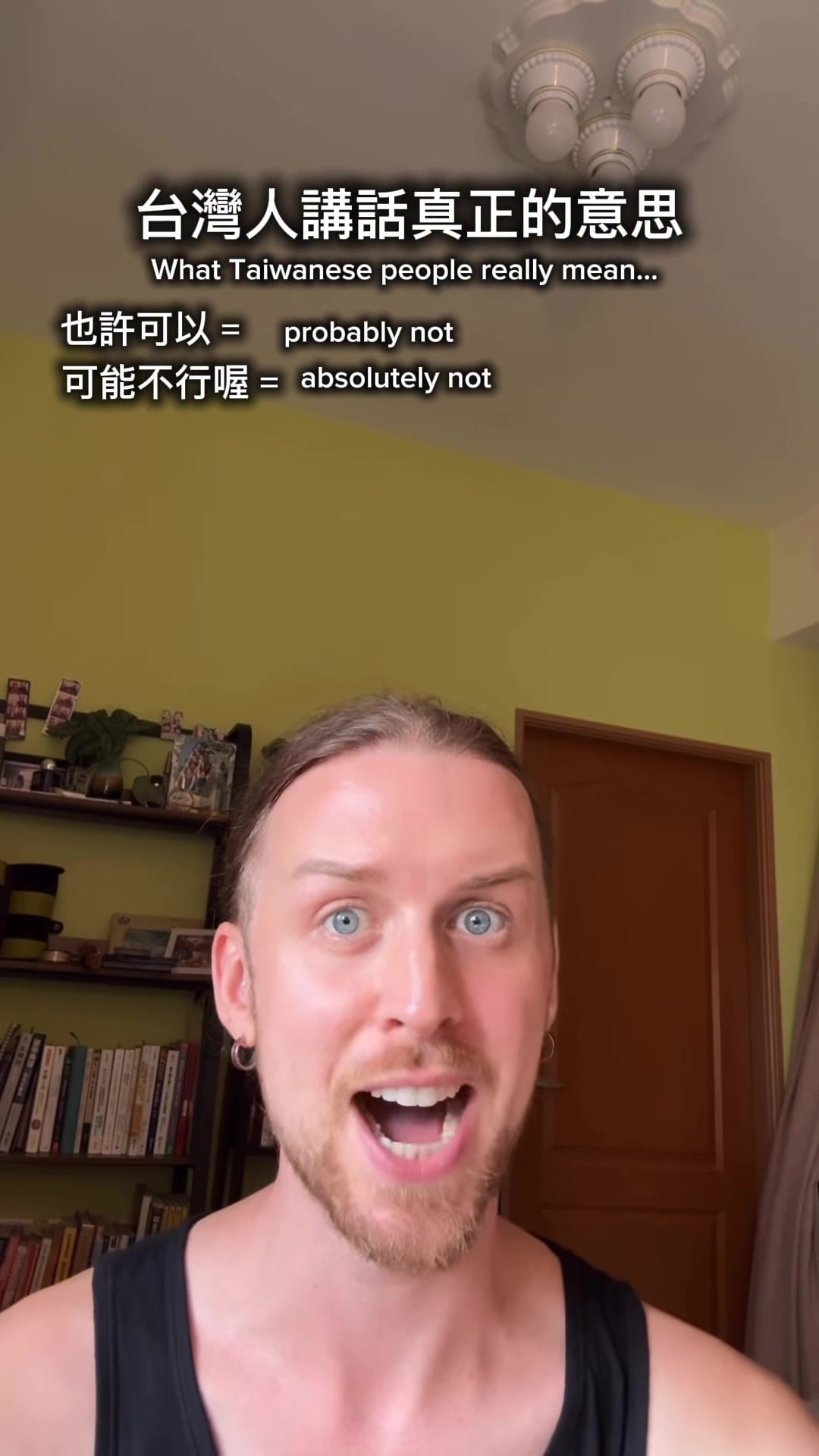
In a bilingual Instagram Reel, comedian Ellery presents a list titled ‘What Taiwanese people really mean.’ Each Mandarin phrase is paired with an English line that states what the sketch claims the speaker is actually thinking.
The softened refusals come first. ‘也許可以,’ or ‘maybe,’ becomes ‘probably not.’ ‘可能不行喔,’ which gently suggests that something may not work, becomes ‘absolutely not.’ Checking one’s schedule is translated even more directly as ‘I’m not interested.’

The list then moves into timing and everyday friction. ‘我快到了,’ or ‘I’m almost there,’ becomes ‘I’ll be there in 30 minutes.’ A polite request to pass becomes an uncensored demand to get out of the way, while ‘可能要想一下喔’ is rendered as ‘That’s a terrible idea.’
The final entries distinguish between levels of apology and dislike. ‘不好意思’ becomes ‘I’m not that sorry,’ while the more direct ‘對不起’ signals that the speaker genuinely messed up. Ellery frames the Reel as a language lesson for foreigners and a joke for Taiwanese viewers, but it works best as a sketch about how tone and context can carry a second conversation beneath the words.